
What is sustainable clothing?
Spoiler: The answer isn’t what the industry wants you to hear.
We get this question all the time. From customers, from journalists, from people we meet out on the trails. And it’s a fair question – one that deserves an honest answer, not the polished greenwashing soup the rest of the industry is serving.
So let’s go through the options. One by one. No sugarcoating.
Note: It takes about four minutes to read. If you want the short version, watch the video or skip to the conclusion at the bottom.

Which fibre is best for the environment? Wool, cotton, polyester or Tencel?
The short answer is very simple: it’s impossible to say.
It all depends on what matters most to you. Are you more concerned about greenhouse gas emissions, microplastics, degradation of ecosystems, etc.? No fibre is clearly best across all aspects.
And here’s the thing we really should understand:
Clothing brands want fibre choice to seem important, because then they can say, “we have a sustainable fibre, so buy this one.”
But the footprint from dyeing a garment is often higher than the footprint from producing the fibre itself. So if you care about impact, fibre choice isn’t actually the most important factor.
As always, what matters most is how much clothing you buy – not which clothing you buy.
That said, at Northern Playground we’re convinced that plastic-based products (polyester, etc.) are not the way forward – neither for the planet nor for the industry. It’s a value choice, both in terms of plastic waste and the simple fact that most people prefer natural materials over plastic on their skin over time.
So with that in mind – what should we actually choose when buying clothes?
Option 1: Second hand
Second hand is good. Really good.
When you buy used clothing, you avoid the production of new garments – and that’s where the biggest environmental impact lies.
But second hand is not a magic fix.
A used garment sitting unused in your closet is not sustainable.
And the growing second hand market has, unfortunately, also become an excuse to buy more.
“It’s just second hand!” Sure. But more is more, regardless.
Especially when many people end up buying more new clothing because it’s so easy to resell it later. Some studies even suggest that second hand can contribute to increased production of new clothing.
And not all garments are suited for second hand. Underwear, socks, sportswear – most of it gets thrown away, not resold.
P.S. We have second hand too!
Option 2: Recycled materials
Recycled polyester from plastic bottles! Sounds good, right?
Partly. Using existing materials is better than making new ones from scratch. But here’s what the industry doesn’t tell you: recycled synthetic materials shed microplastics every time they’re washed.
Studies estimate that a single wash can release hundreds of thousands of microplastic particles – ending up in the ocean and in our food chain. So far, there’s no good solution to this.
And the recycling process itself isn’t footprint-free.
It’s especially problematic when plastic bottles are turned into clothing instead of continuing to be recycled as bottles.
On top of that, garments made from recycled materials are often less durable than those made from virgin fibres. Shorter lifespan means you’ll need to replace them sooner – and the equation isn’t always as “green” as the marketing suggests.
There are some players working with recycled natural fibres using purely mechanical processes that require relatively few resources. Even though this also has an impact – and the fibres can be of lower quality than virgin ones – we think this is a very interesting direction for the future.
P.S. We have wool vests, wool beanies and cotton shirts made from recycled materials.
Option 3: Organic materials
The production of organic wool and cotton avoids synthetic pesticides, which is better for the soil, ecosystems, and the people working in the fields. Those are real benefits.
But organic cotton, for example, uses just as much water as conventional cotton. And as with everything in this space: the biggest footprint of a garment often comes from washing and dyeing processes at the factory – not from the fibre production itself.
Also, organic or not – it doesn’t help much if the T-shirt is thrown away after one season.
P.S. Many of our products are GOTS-certified organic, and we believe that’s clearly better than not having it. Our wool and silk products are a good example.
Option 4: Renting clothes
Renting garments for special occasions – a wedding dress, a blazer, a snowsuit for a single ski trip – makes a lot of sense.
But subscription models where you continuously rent new clothes? That might be the marketing department’s dream, not the planet’s.
Logistics, shipping, washing, and returns between each user all come with a significant footprint. And once a garment starts to show visible signs of wear, it’s often no longer rented out.
The sharing economy can absolutely have its benefits, but the research isn’t clear-cut when it comes to the environmental impact of rental. Sometimes it’s positive, other times it can be worse than owning something yourself.
The rest is… complicated.
P.S. We don’t rent out clothes. We believe that sometimes it’s better to really love a product – and keep it for a long time.
Option 5: Certifications and brands that promise “green”
B Corp. Climate Neutral. 1% for the Planet. Bluesign. We respect the work behind many of these.
But we’ll say it straight: a certification doesn’t change the fundamental problem. A production process can never be completely without impact.
We know – because we are a clothing brand.
We know how this works.
P.S. Our manufacturers and products carry a range of certifications that we’re proud of.
What the research actually says
Here’s the interesting part: all life cycle analyses (LCA studies) of clothing agree on one thing – regardless of which materials or systems they compare.
The single most effective environmental action you can take is to use your clothes for a long time.
This has been shown again and again – from studies on wool sweaters to cotton T-shirts to synthetic jackets.
Doubling the lifespan of a garment roughly halves its climate impact per wear.
It’s not magic. It’s just logic.
So what should you do?
Buy fewer clothes.
That’s the best and simplest thing you can do.
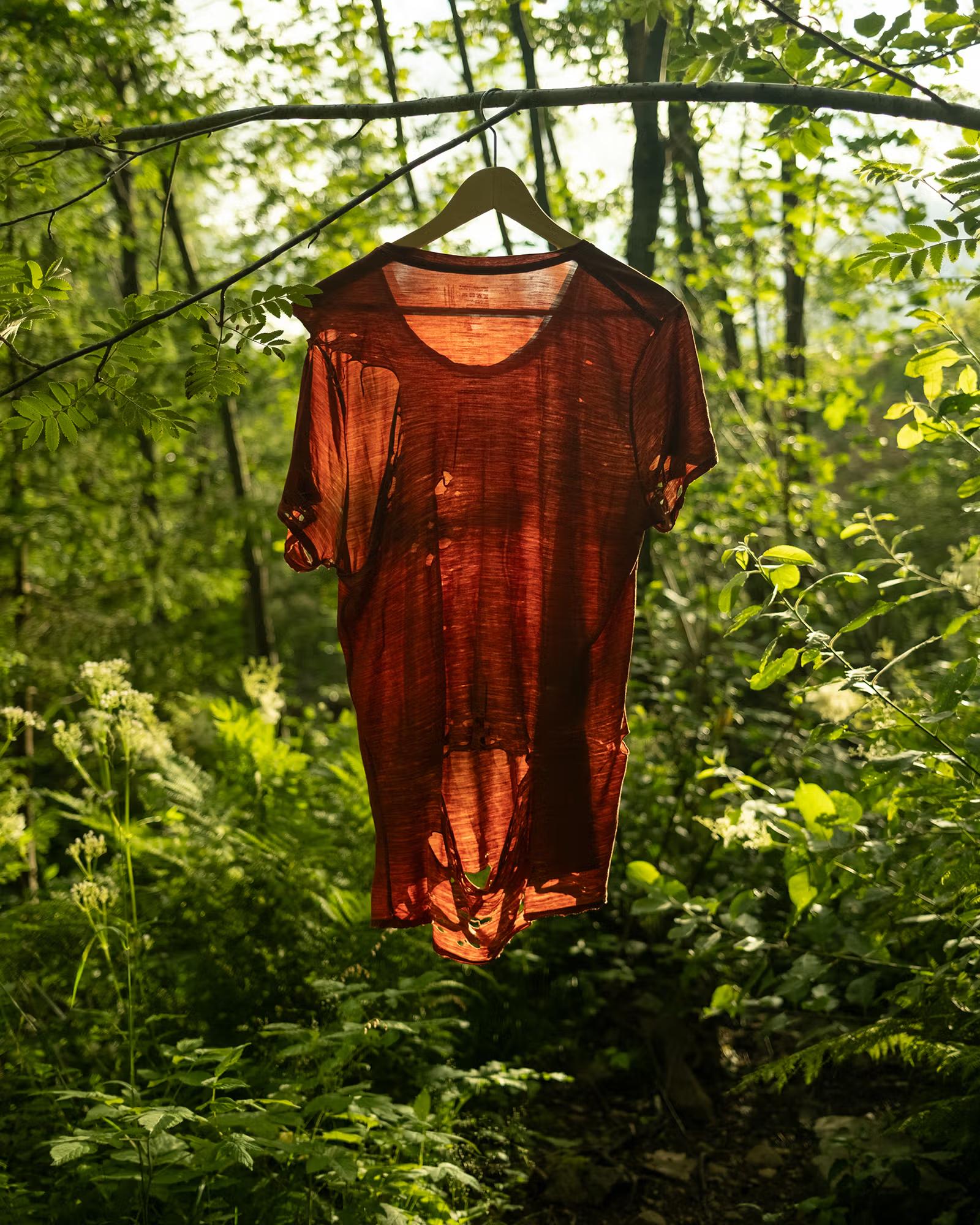
And when you actually need something new: buy something that lasts. Something you’ll still want to wear in ten years. Something that can be repaired and doesn’t fall apart after one season in the mountains.
That’s it.
No fancy certification. No subscription. No influencer campaign.
Just a garment, used for a long time.
We make clothes we hope you’ll use until they’re worn out. That’s why we exist.
Sources
Wiedemann, S.G., Biggs, L., Nebel, B., Bauch, K., Laitala, K., Klepp, I.G., Swan, P.G. & Watson, K. (2020). Environmental impacts associated with the production, use, and end-of-life of a woollen garment. International Journal of Life Cycle Assessment, 25, 1486–1499. https://doi.org/10.1007/s11367-020-01766-0
Munasinghe, P., Druckman, A. & Dissanayake, D.G.K. (2021). A systematic review of the life cycle inventory of clothing. Journal of Cleaner Production, 320, 128852. https://doi.org/10.1016/j.jclepro.2021.128852
Farrant, L., Olsen, S.I. & Wangel, A. (2010). Environmental benefits from reusing clothes. International Journal of Life Cycle Assessment, 15(7), 726–736. https://doi.org/10.1007/s11367-010-0197-y
Laitala, K., Klepp, I.G. & Henry, B. (2018). Does use matter? Comparison of environmental impacts of clothing based on fiber type. Sustainability, 10(7), 2524. https://doi.org/10.3390/su10072524